1. Why mass-discount snack retail emerged
Every dominant snack channel in China has been a child of its macro era. The hypermarket and specialty-store decade (2000–2012) monetized rapidly rising incomes through breadth of assortment. The e-commerce decade (2013–2021) monetized logistics and platform reach through convenience and brand storytelling. The current era is different in kind: nominal growth has slowed, food prices have hovered near deflation, and the binding constraint has flipped from demand to supply. In that environment, the channel that wins is the one that strips cost out of distribution — which is precisely what the mass-discount format does.
1.1 Supply: chronic overcapacity created the raw material
Snack manufacturing has low entry barriers, and capacity has accumulated well ahead of demand. Food-manufacturing capacity utilization averaged roughly 70% from 2022 through early 2026 — below the broader manufacturing complex and trending lower — while PPI printed negative year-on-year through 2023–2025 and headline CPI sat below 1%. Producers facing idle lines and inventory pressure became willing suppliers of cheap, abundant and stable product to any channel that could guarantee volume and pay quickly. The mass-discount chains are that channel.
1.2 Demand: the pivot from premiumization to value-for-money
Consumer confidence broke down in 2022 and has not recovered to pre-2022 levels (Exhibit 2). But weak confidence did not kill snacking — it reshaped it. Snacks are small-ticket, high-frequency, instant-gratification purchases: per industry survey data (iiMedia), over 60% of consumers buy snacks 3–5 times per month, and most basket sizes fall below RMB 50, with the RMB 30–50 bracket the single largest. Spending of this profile is relatively insensitive to budget tightening; what shifted is the demand for quality at a fair price rather than either pure low price or premium positioning. A channel offering branded and credible white-label product at visibly lower prices is the cleanest expression of that preference.
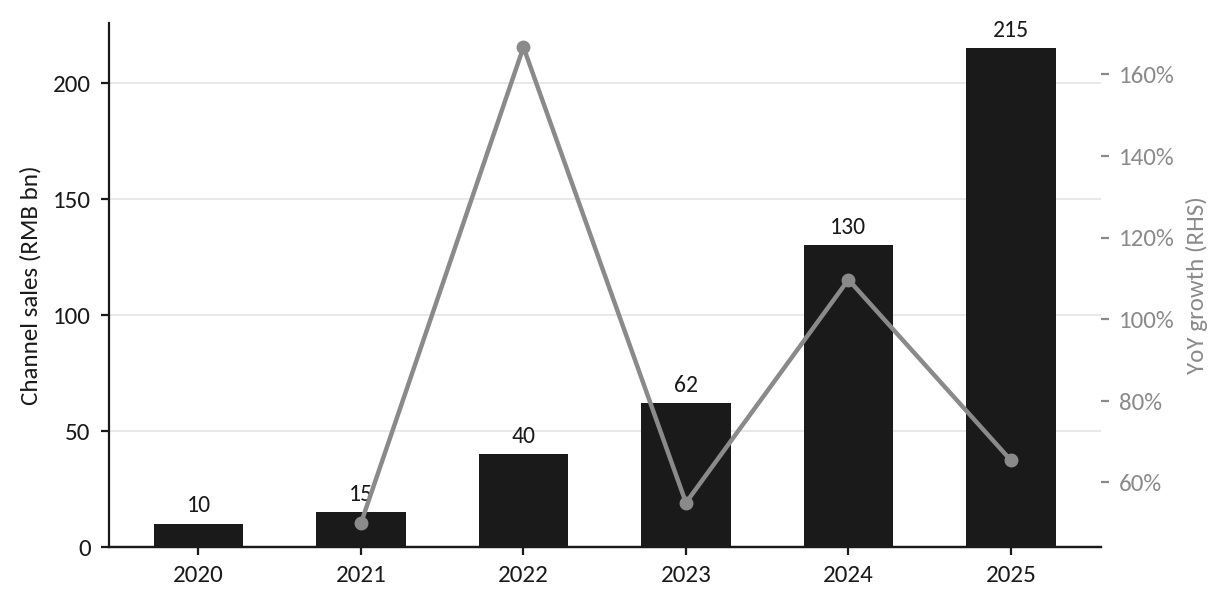
Source: Wanchen Group HK IPO prospectus; Sealand Securities (May 2026); Mortise Capital Research. Values approximate.
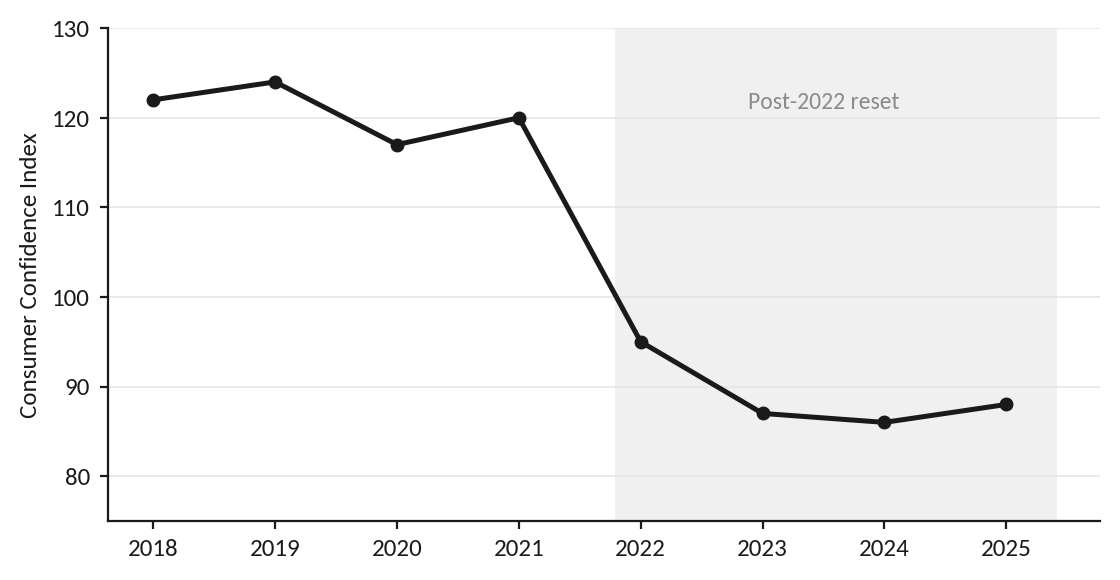
Source: National Bureau of Statistics, Wind; Mortise Capital Research. Annual averages, approximate.
1.3 Channel succession: each era’s winner solved that era’s constraint
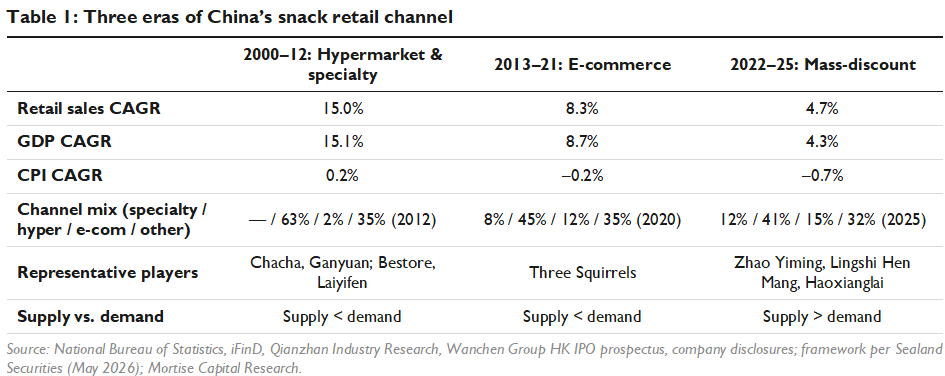
Table 1 summarizes the three channel eras. Note the inversion in the final column: for the first time, supply exceeds demand, which transfers bargaining power to the retailer that controls shelf velocity. Traditional hypermarkets carry high fixed costs and slow SKU rotation; e-commerce lacks immediacy and physical experience just as online traffic costs peak; mom-and-pop stores cannot match assortment or quality control. The mass-discount store occupies the gap: more vertical and efficient than the hypermarket, more immediate and experiential than e-commerce, cheaper and broader than premium snack boutiques.
The format also found its natural habitat in lower-tier cities. Rural disposable income compounded at 7.3% over 2019–2025 versus 4.9% for urban households, lifting demand for “good but not expensive” consumption exactly where rents and labor are cheapest, franchise networks can lean on local trust to solve siting and hiring, brand sensitivity is low (favoring higher-margin white-label product), and county-level logistics are already mature. The result: payback periods short enough to support explosive franchised expansion, with roughly 60–70% of leading networks’ stores in tier-3 and below cities (Exhibit 6).
2. The business model: monetizing supply-chain efficiency
Strip away the branding and a mass-discount snack store is a hard discounter for a single vertical. It earns an “efficiency spread” — the difference between what legacy distribution costs and what its compressed chain costs — and shares part of that spread with the consumer as price. We frame the consumer proposition on four axes, in order of importance: Cheap (省), Fast (快), Broad (多), Good (好). “Cheap” is the detonator that wins first visits; the other three determine whether visits become habits.
2.1 Cheap: efficiency, not subsidy, funds the discount
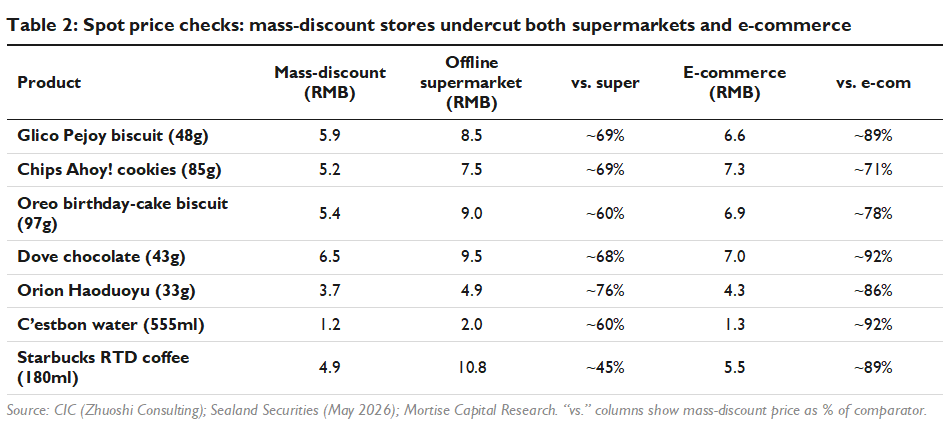
Shelf prices run roughly 20–30% below traditional supermarkets and, on many SKUs, below e-commerce (Table 2). Three mechanisms fund this sustainably. First, chain compression: top-to-top direct sourcing bypasses tiered distributors, cutting the cumulative channel markup from ~2.0x of factory price to ~1.5x (per Xinjingxiao / China Hard-Discount Snack White Paper) and eliminating slotting and barcode fees. Second, velocity economics: small-pack formats and tight supply-chain control hold inventory days to 10–20 versus ~50 at conventional supermarkets, while payables clear inside 20 days (Exhibits 3–4) — fast cash for suppliers, who reciprocate with better pricing, closing a self-reinforcing loop of low price → high turnover → fast settlement → better procurement terms → lower price. Third, scale: store-count growth has pushed head operators’ food purchasing volumes toward parity with legacy retail giants, hardening negotiating leverage.
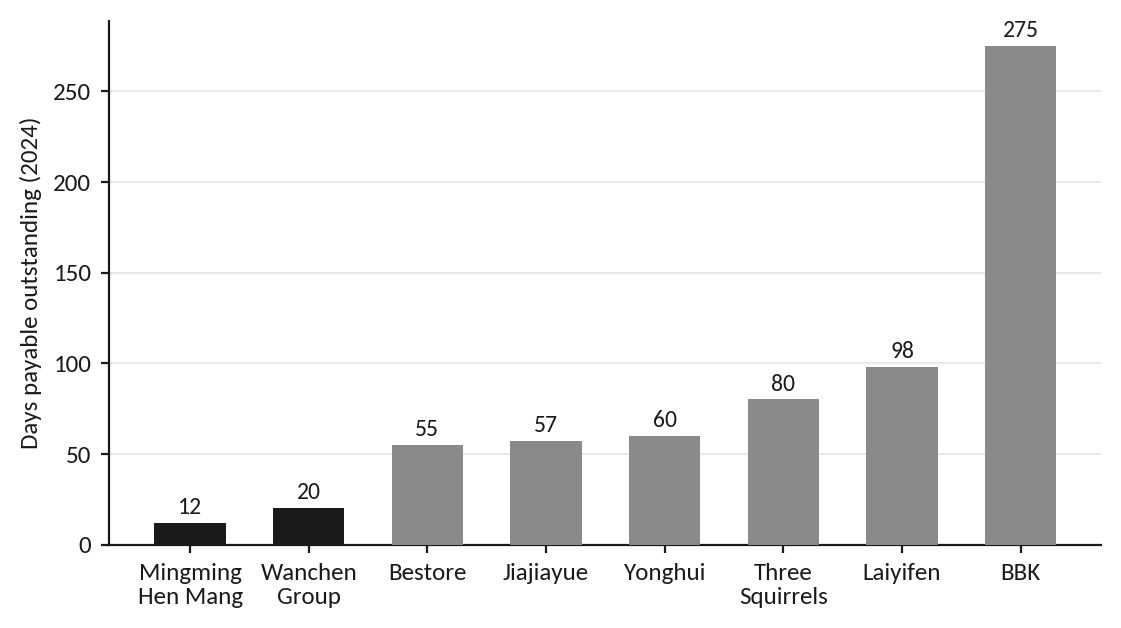
Source: Mingming Hen Mang company filings, iFinD, FY2024; Sealand Securities; Mortise Capital Research. Values approximate.
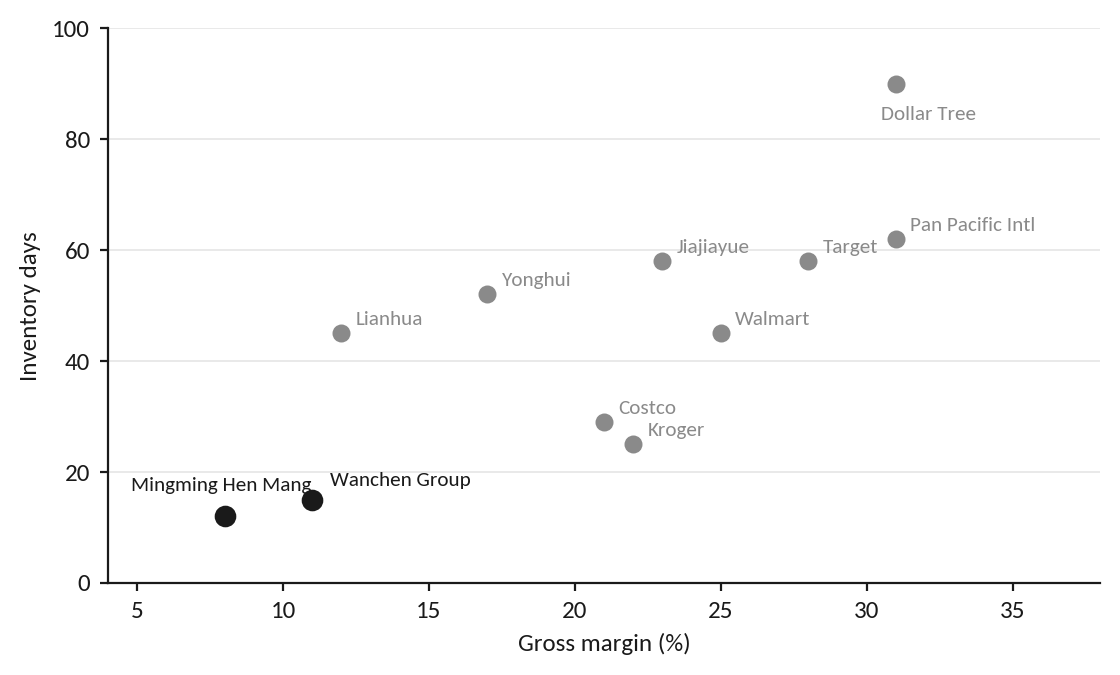
Source: Company filings incl. Pan Pacific International, iFinD, FY2024; Sealand Securities; Mortise Capital Research. Values approximate.
Margin architecture follows the same logic (Exhibit 5). Per Zhiyan Consulting, tier-1 national brands carry sub-10% gross margins on roughly 10% of SKUs — they exist to anchor the store’s low-price reputation. Tier-2 and specialty brands earn 10–15% on up to ~30% of SKUs. The profit pool sits in white-label and bulk product: gross margins above 30% on more than 60% of SKUs. Small-pack, low-ticket pricing completes the design, matching the impulsive, high-frequency offline occasion that bulk-pack e-commerce cannot serve, and lowering the cost of trial across many categories.
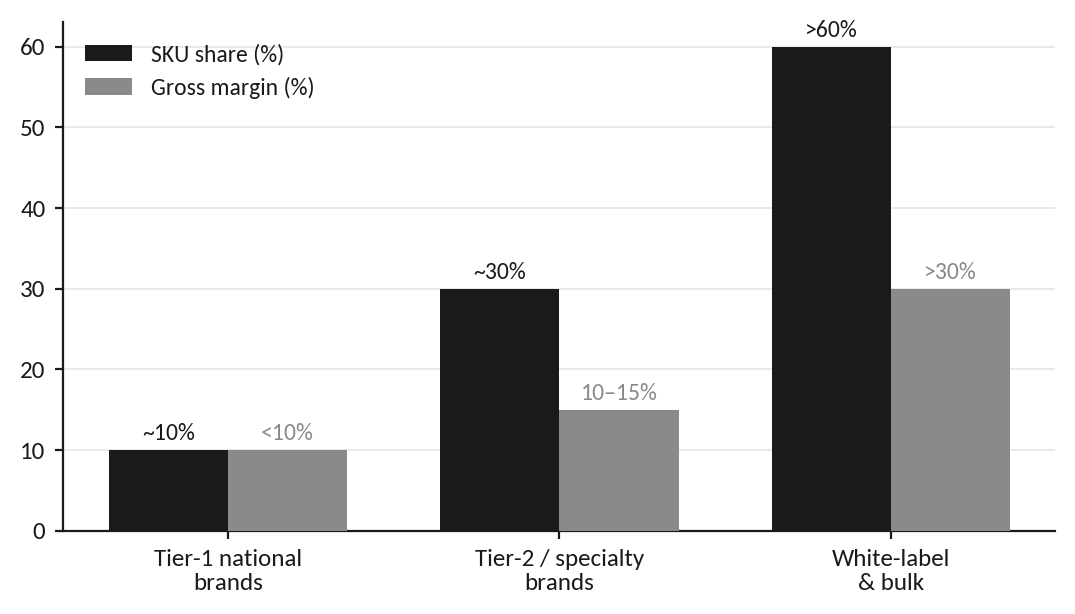
Source: Zhiyan Consulting; Sealand Securities (May 2026); Mortise Capital Research. Reported as ranges; bars plotted at indicative values.
2.2 Fast: density converts snacking from planned to impulsive
“Fast” here means a short path from craving to consumption. Stores cluster in communities, around schools and on commercial streets — over 80% of Lingshi Hen Mang’s Changsha stores are community sites — placing the format inside the consumer’s daily routine and converting snack buying from a planned shopping trip into an instant top-up. Depth of penetration matters as much as proximity: roughly 69% of Mingming Hen Mang’s 2024 store base sits in tier-3 and below cities (Exhibit 6), where high community density, low rents and a thin incumbent modern-retail presence allow a standardized store model to replicate quickly while delivering big-city convenience to small-city consumers.
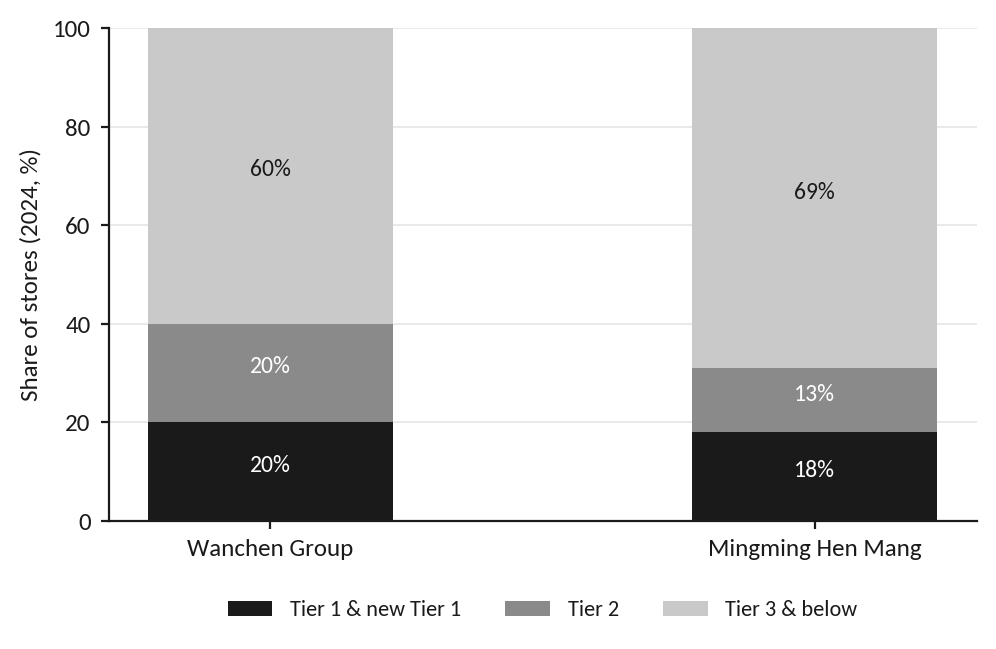
Source: Company IPO prospectuses (Wanchen Group, Mingming Hen Mang); Sealand Securities; Mortise Capital Research.
2.3 Broad: assortment depth plus relentless rotation
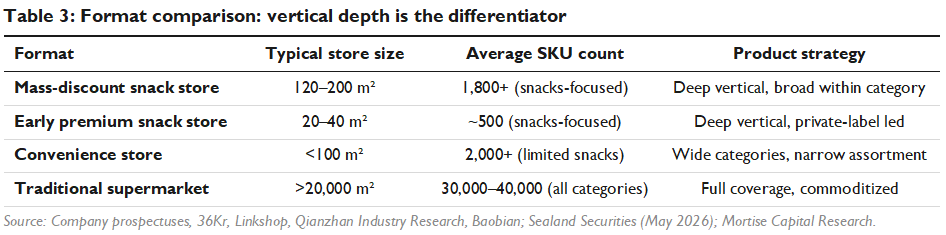
A typical store carries 1,800+ SKUs of snacks and beverages — vertical depth no generalist can match within the category (Table 3) — and head operators refresh 100–300 SKUs per month. Crucially, the economics of Section 2.1 de-risk experimentation: low listing barriers, fast turnover and quick settlement let chains trial novel products from small and mid-sized brands cheaply, then let sales data select the winners. Assortment breadth is therefore not just merchandising; it is an output of the supply-chain model.
2.4 Good: quality control is the moat against the mom-and-pop store
With value secured, “good” builds the trust that sustains the brand. Known national brands lend credibility on shelf; white-label suppliers are curated “hidden champions” of their niches that have scaled and upgraded alongside the channel. Because supplier counts are large, quality control is existential: leaders run end-to-end systems — Mingming Hen Mang’s “six audits, six inspections” spans production, transport, warehousing, store sale and after-sales — which structurally separates the format from the loose standards of street-corner stores. Bright, well-organized, self-service store environments complete an experience upgrade over the channel it most directly displaces.
3. How durable is the model?
We do not view the channel’s rise as a transient arbitrage. On the demand side, snacking is high-frequency, small-ticket and weakly cyclical — demand is, if anything, more resilient when budgets tighten — and the value-for-money preference looks structural so long as deflationary expectations persist. Lower-tier consumption upgrading and population backflow widen the addressable gap that hypermarkets (high cost, slow iteration) and e-commerce (no immediacy, no experience) cannot serve. On the supply side, food-manufacturing overcapacity continues to guarantee cheap, stable sourcing, while the channel disciplines upstream players toward higher quality and efficiency.
On the model side, the hard-discount mechanics compound: top-to-top sourcing with near-cash settlement keeps the markup chain compressed; high turnover and low expense ratios deliver fulfillment efficiency superior to both hypermarkets and e-commerce; SKU depth, rapid rotation and community density drive superior sales per square meter, per employee and per SKU. “Cheap” keeps acquiring customers; “Fast, Broad, Good” form a closed loop of repeat purchase. Growth from here comes from three vectors: continued white-space store penetration, format iteration (fresh-snack concepts such as Jinlimen and Pumama adapting the model for higher-tier cities), and second growth curves in adjacent sub-categories that further accelerate turnover.
4. Risks
• Expansion quality. The format is scale-driven; if unit economics or store-opening discipline deteriorate as networks nationalize, industry growth slows.
• Competitive intensity and price wars. Irrational discounting or subsidy battles could compress industry margins; disorderly franchise competition risks management and service quality.
• Homogenization and consumer fatigue. As assortments converge from “SKU expansion” to “curated control,” undifferentiated offerings could erode basket size, repeat frequency and loyalty.
• Food safety and quality control. High SKU counts and heavy white-label exposure make quality-control failure a tail risk with outsized reputational consequences.
• Supply-chain and cost volatility. Rapid expansion plus fast SKU rotation raises the bar for supply-chain stability; upstream price swings or under-investment in logistics and warehousing would hit cost structure and gross margin directly.
Sources & attribution
This note is an original Mortise Capital synthesis prepared for internal research and training purposes. The analytical framework and several data series draw on: Sealand Securities Research, “The Snack Efficiency Revolution — Snack Industry Transformation Series, Part I” (Liu Xude, Xiao Yue; May 18, 2026). Underlying data sources as cited under each exhibit and table include: National Bureau of Statistics, Wind, iFinD, Wanchen Group and Mingming Hen Mang HK IPO prospectuses and company filings, Pan Pacific International filings, CIC (Zhuoshi), Zhiyan Consulting, iiMedia, Black Ant Capital, Xinjingxiao “China Hard-Discount Snack White Paper,” Qianzhan Industry Research, Jihai, 36Kr and Linkshop. Figures read from charted sources are approximate. This document paraphrases and restructures third-party analysis; it is not a translation of, and should not be redistributed as, the original report.
Disclaimer: Mortise Capital is a student-led investment research organization. This material is for educational and informational purposes only and does not constitute investment advice, an offer, or a solicitation to buy or sell any security. Data are believed reliable but are not guaranteed. Opinions are those of the authors as of the date hereof and are subject to change without notice.